The line
Mapping Crimea honestly: de-facto, de-jure, and the cost of choosing
2026-06-28 · 4 min
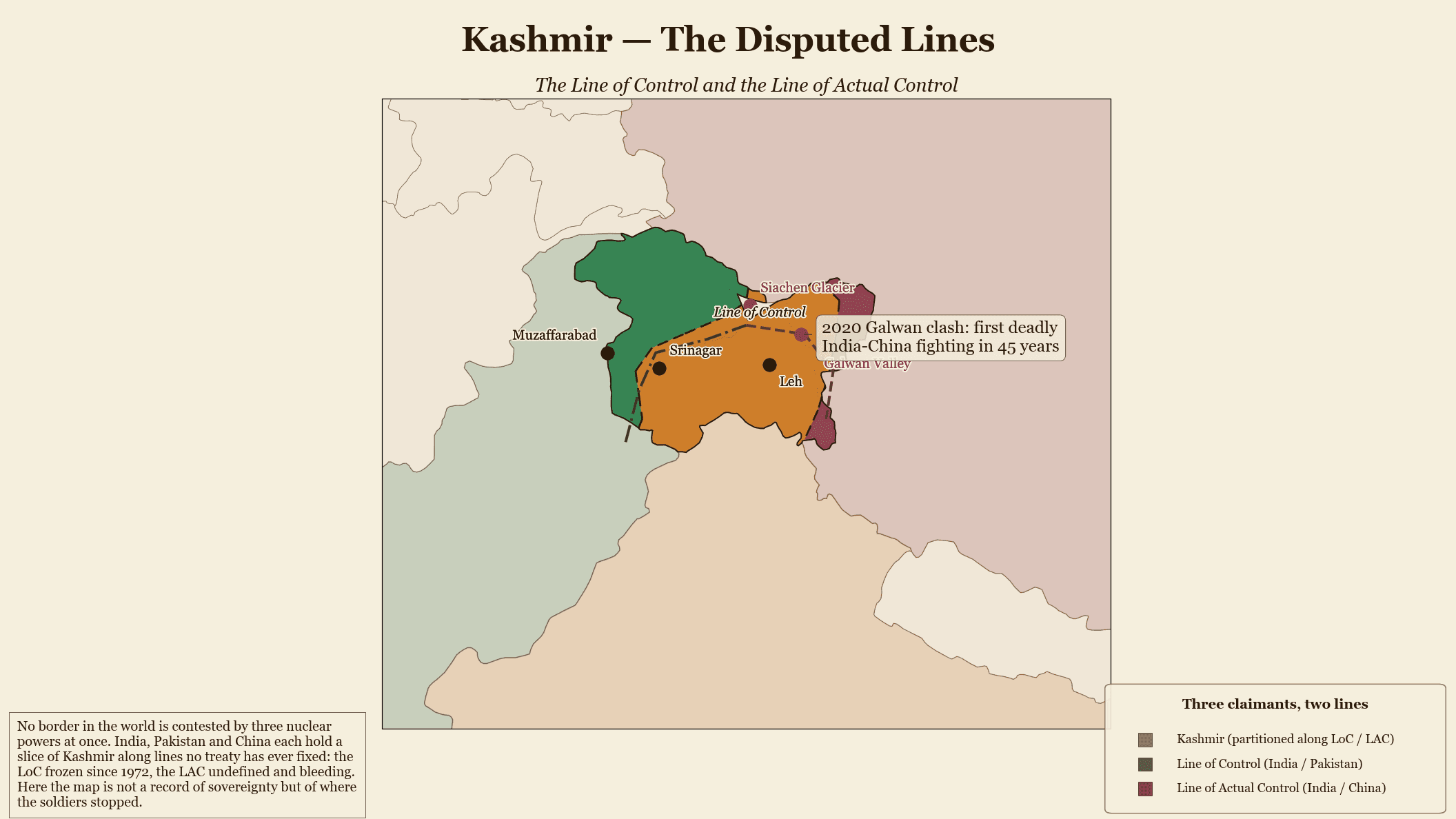
Draw a line around Crimea and you have already taken a position. There is no version of the map where the pen stays neutral: to shade the peninsula one colour is to answer a question the world has not settled, and to leave it uncoloured answers it too. The cartographer's oldest illusion is that the map merely records what is there. It does not. It chooses. The only honest question is whether the choice is visible.
There is no neutral map
We tend to treat borders as data — coordinates to be looked up, coastlines to be traced. For coastlines that is roughly true. For political boundaries it is not. A boundary is a claim that some authority recognises and some other authority rejects, and the disagreement is the whole substance of the thing. When a map presents such a boundary as a single confident line, it is not omitting an opinion; it is smuggling one in under the costume of fact.
This matters most precisely where the stakes are highest. An analyst briefing a defence audience, a newsroom illustrating a diplomatic dispute, a lecturer teaching the post-2014 order — each needs the reader to know which claim is being drawn, and on whose authority. A map that hides its assumption about Crimea is not simply incomplete. It is professionally unusable, because it cannot be audited, and politically compromising, because it commits the author to a position they may never have meant to take.
What a disambiguation is
In Gesta Carta a contested territory is not a styling accident settled by whoever picked the fill colour. It is a first-class node in the map document — a disambiguation with an explicit, recorded mode. The tool does not silently pick one for you and move on. It asks, and the answer stays legible in the document afterward, where anyone can read it, cite it, or change it.
For Crimea the relevant modes are familiar to anyone who works in this field:
- de-facto — the line as effective control is exercised on the ground. Post-2014, the peninsula is rendered as administered by the Russian Federation.
- de-jure — the line as recognised in international law. Here Crimea renders as territory of Ukraine, consistent with the prevailing position of UN member states.
- dual — both claims held in the same frame, the contestation shown as contestation rather than resolved to one answer.
The document does not merely look different in each mode; it says which mode it is in. A field such as disambiguation_state records the decision, so that the map carries its own footnote. The line you see is bound to a declared reason for drawing it there.
Time is part of the claim
A border is also a statement about when. "Current borders" is not a specification — current as of which year? Crimea's de-facto line before 2014 is not the line after it. So the disambiguation carries a temporal validity: borders as of a stated date. This is not pedantry. A map of the region dated 2013 and one dated 2023 are different arguments, and conflating them is a category error that no amount of careful colour choice can repair. The document pins the year, and the year travels with the map.
The same logic, everywhere it is needed
Crimea is the clean worked example, but the machinery is general. Kashmir carries competing administrations and lines of control that no single stroke honestly summarises. Western Sahara sits between claimed sovereignty and effective control across a dividing wall. Taiwan and Kosovo each split the world's recognition down the middle. And the dispute is not always territorial: the same body of water is the Persian Gulf or the Arabian Gulf depending on who is speaking, so a toponym gets a dual-name mode rather than a silent editorial pick.
In each case the tool's instinct is the same. It refuses to resolve the ambiguity behind your back. It surfaces the choice, names the modes, and keeps the decision in the document where it can be inspected.
Why the harder path is the rigorous one
It would be easier to ship a "neutral" default and let readers assume the software knew best. It would also be dishonest, because the neutral default does not exist — every default is a position wearing plain clothes. Making the position explicit is not a hedge or a disclaimer. It is the more rigorous act: it states the claim, attributes it to an authority, dates it, and leaves the door open to render the other claim beside it.
A map that can show its contestation is more useful, not less. It survives scrutiny. It can be defended in a footnote and reproduced by a reviewer. It tells the reader what kind of statement it is making — de-facto, de-jure, or both at once — instead of asking them to guess.
The line will always be a decision. What Gesta Carta insists on is that the decision be spoken aloud and kept in view. That is where trust in a map begins: not in the pretence that it took no position, but in the plainness with which it tells you the one it took.