Method
Why the renderer is deterministic — and why that matters
2026-06-24 · 4 min
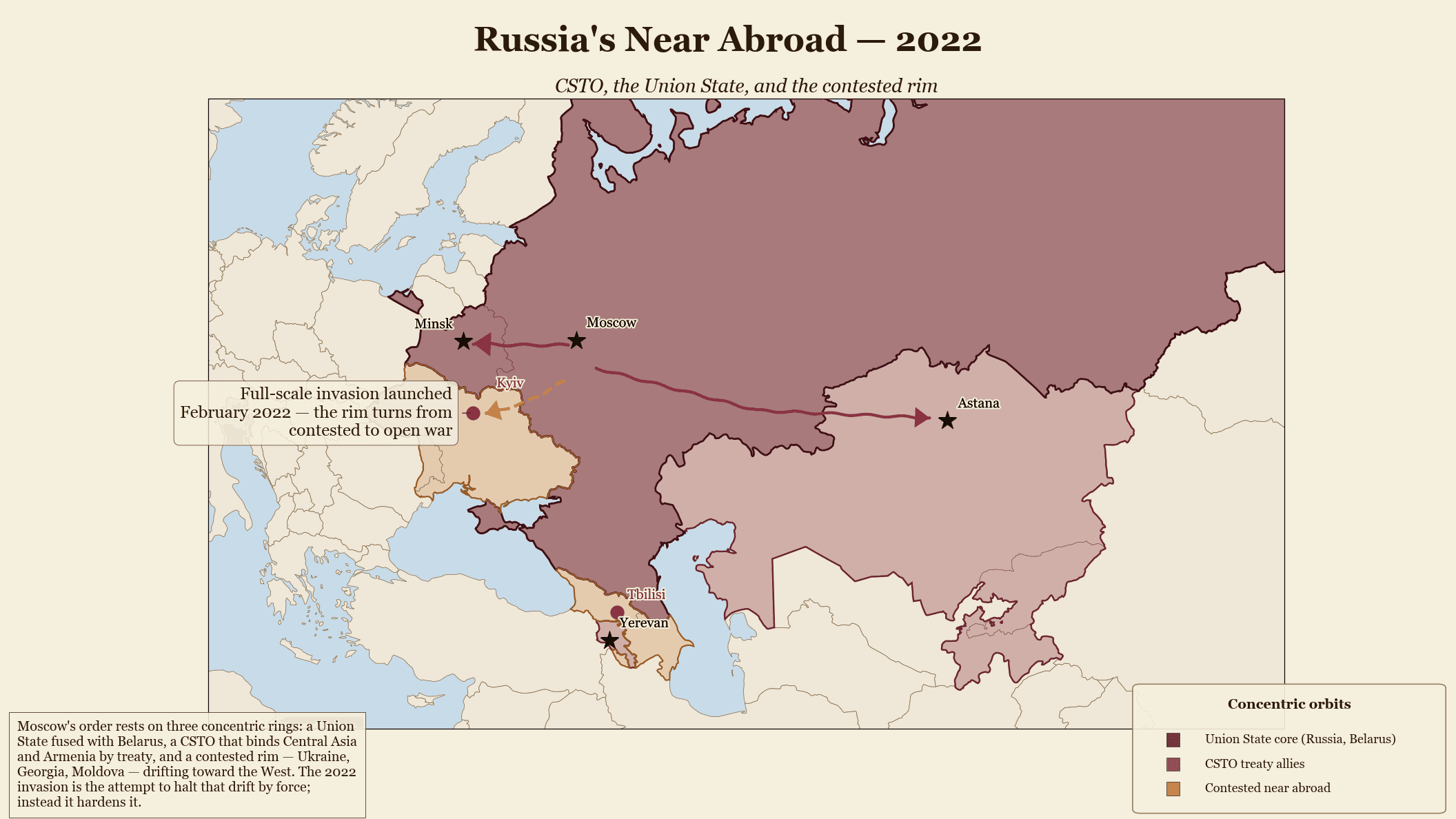
A map is an argument. It selects, it emphasizes, it draws a border here and a zone of influence there, and in doing so it asks you to believe something about the world. The oldest question a reader can put to an argument is also the simplest: let me see how you got there. For prose we answer with footnotes. For a map, the equivalent answer is a document you can run again and a plate that comes back identical. That is what determinism buys, and it is the reason we treat it as a first principle rather than an implementation note.
What determinism actually means here
The bet at the center of Gesta Carta is that the model never draws. It writes — a declarative document, a cartographic DSL, that names entities and states relations: this territory, that zone, this arrow from one capital to another. A separate renderer, deterministic by construction, turns that document into SVG. Determinism here has a precise meaning: the same document produces the same map, byte for byte. Not visually similar. Not close enough. The same plate.
This is easy to underestimate because it sounds like plumbing. It is not plumbing. It is the difference between a map that can be held accountable and one that cannot.
The contrast with image generation
Consider the alternative that the current moment makes tempting: describe a map in words, let a model paint the pixels. The output can be beautiful. It is also, in the sense that matters, unaccountable. Ask the same system for the same map twice and you get two different images. There is no document behind them — only weights and a seed — so there is nothing to inspect, nothing to correct at the source, nothing to cite. A coastline drifts; a border softens; a country the reader knows is landlocked grows a harbor. You cannot check such a map, because there is no it to check. Each render is a fresh, private accident.
A cited map has to survive scrutiny it did not anticipate. Someone will disagree with where you put a line. The only honest response is to hand over the document and say: here is exactly what I claimed, here is the plate it produced, reproduce it yourself. Image generation cannot make that offer. Determinism is the precondition for making it.
Geometry the renderer owns, not the model
There is a second half to accountability that determinism protects. Because the model works on named entities and the renderer resolves them to authoritative geometry, the shape of Russia is not a thing the AI invents — it is a thing the renderer looks up. The model cannot hallucinate a coastline because it never touches one. Named entities in, real geometry out, every time.
Some entities are not in the local dataset and have to be resolved online. That is a live wire for reproducibility: an external lookup that answers differently next week silently changes your map next week. So we snapshot it. The moment a place is resolved, its geometry is captured into the document, and from then on the renderer reads the snapshot, not the network. The map stops depending on the weather of the internet. It becomes, again, a closed thing you can run in a year and trust.
What the plate is made of
Determinism also shapes the output itself. The SVG is not a flat picture but a structured plate — a layer per element, each carrying the id it had in the document. The zone is a layer. The arrow is a layer. The annotation is a layer. You can open the file and find the argument still articulated inside it, every stroke traceable back to the line of the document that asked for it. Nothing is baked into an undifferentiated bitmap; nothing is anonymous.
And because the source of truth is a document, it versions like code. A map has a history — this border moved on this date, this zone was added, this claim was withdrawn — and the history is a tree you can branch, diff, and merge, not a linear log of forgotten states. Reproducibility across time, not just across two runs an hour apart.
The quiet part
None of this is austerity for its own sake. The aesthetic is deliberately warm — sepia grounds, interpretive zones, the hand's presence in the linework, an inheritance from the continental editorial tradition rendered in an idiom of our own. Determinism is not the enemy of that warmth; it is what lets the warmth be trusted. A beautiful map that cannot be reproduced is a persuasion you are asked to take on faith. A beautiful map that comes back identical from a document you can read is a claim you can stand behind in public.
That is the whole of it. A footnote works because anyone can follow it to the source and find what you found. We want a map to work the same way — same document, same plate, to the pixel — so that when someone asks how you got there, you have an answer better than trust me. If you open the Studio and make one, keep the document. It is the map's proof of work, and one day a reader will thank you for having kept it.