The school
The warm ground: inheriting a tradition without copying it
2026-07-01 · 5 min
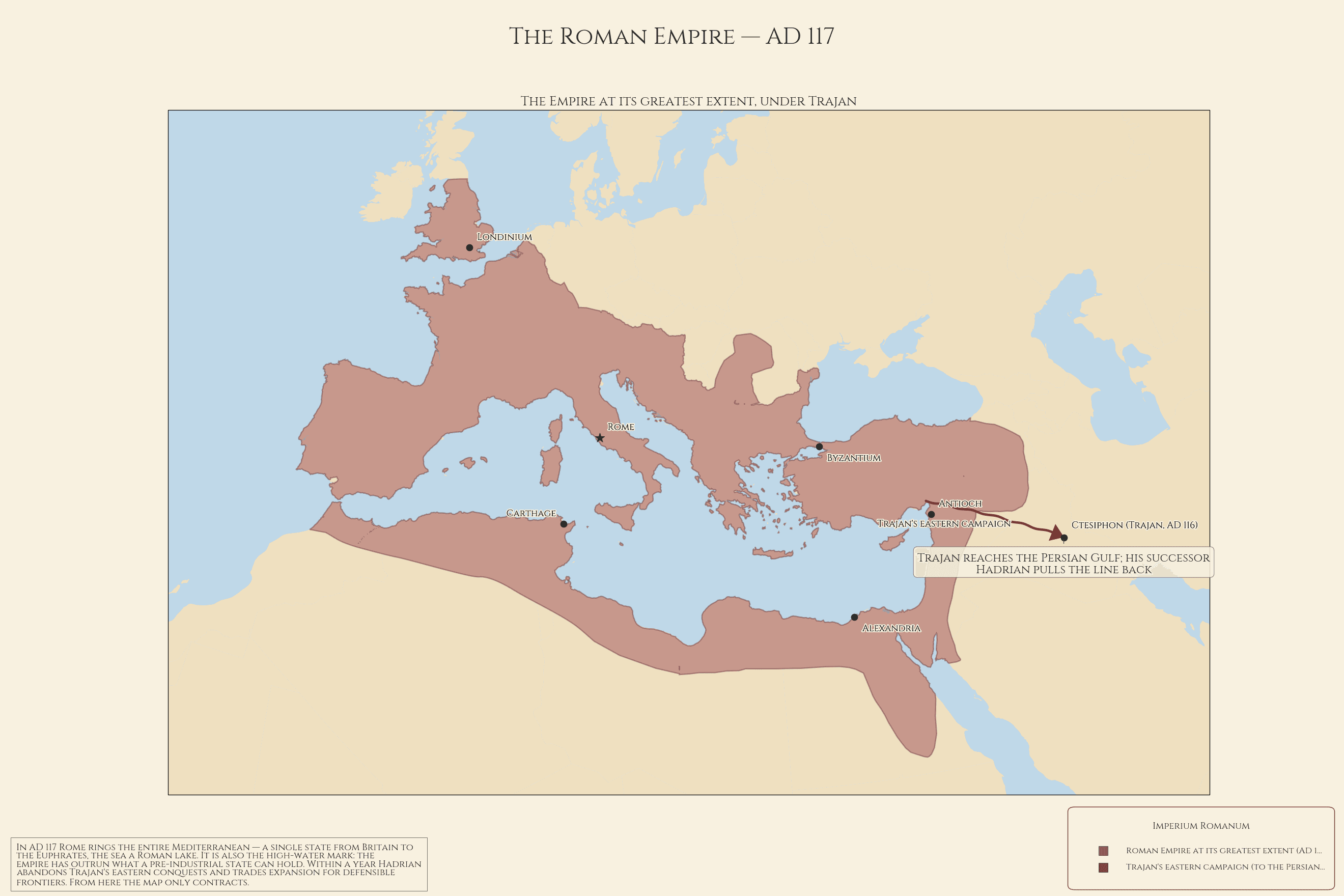
Open a map from the continental editorial tradition and the first thing you notice is that it is warm. Not white. The ground is cream, sometimes sepia, the colour of paper that has been handled. Before a single border is read, the surface has already told you something: a person made this, and a person is speaking to you. That warmth is not decoration. It is the tradition's opening argument, and it is the argument the dominant data-viz orthodoxy quietly abandoned.
A map is an argument, not a dashboard
The continental European editorial school — the Italian editorial cartographers, the Rekacewicz lineage at Le Monde Diplomatique, the historical atlases of Treccani and Garzanti, the plates in Diplomatie — treats a map as a piece of reasoning. It has a thesis. It wants to convince you of something: that this river is a fault line, that this alliance is thinner than it looks, that influence flows in one direction and not the other. Every choice on the page serves the claim.
Contrast this with the Anglo-American data-viz canon — the Economist, Bloomberg, the FT. That tradition is clinical and quantitative. It excels at showing you how much and how many, and it is scrupulous about not editorialising. But in gaining objectivity it lost narrative. A dashboard answers questions you already know to ask. An editorial map tells you which question matters. These are different instruments, and the second one is the one this domain needs.
A good geopolitical map is not made good by absolute accuracy. Accuracy is data — table stakes, non-negotiable, and frankly the least interesting part. What makes a map good is narrative clarity, controlled information density, honesty about what is contested, and aesthetic coherence: the sense that the whole page speaks one visual language. The editorial school got this right because it never pretended a map could be neutral.
Why the warm ground works
The three signature traits of the school are not stylistic tics. Each one is a functional signal.
The warm ground tells the reader this is an authored document, not a machine readout. A cream field lowers the contrast, softens the clinical edge, and — this is the point — invites reading rather than mere lookup. You do not scan a sepia map for a value. You dwell on it. The temperature of the paper sets the temperature of the attention.
The imperfect line — the slightly uneven, faintly hand-drawn border — does the same work at the level of the stroke. A perfectly geometric vector line claims a false precision: it implies the boundary is as certain as the pixel. A line with a little tremor in it admits that borders are human artefacts, drawn and redrawn by hands. Paradoxically, the imperfect line is the more honest one. It signals interpretation where a crisp line would smuggle in authority.
The interpretive zone — the coloured wash for a sphere of influence, the dense arrow, the annotation that reads contested since 2014 rather than a bare label — is the school's boldest move. It puts the analyst's judgement openly on the page. Anglo data-viz would banish such a zone as unrigorous. The editorial school understood that the judgement is the value. The reader is trusted to see the wash for what it is: a claim, made visible, and therefore arguable.
Together these traits produce a map that has a voice. And a voice is exactly what invites a reader to lean in, to agree or push back — to think with the map instead of merely querying it.
Inheriting DNA without cloning a style
Here is the honest tension, and we will not paper over it. The traits above are the DNA of a school. But a specific cartographer's rendering of that DNA — a particular palette, a particular hand, a signature way of drawing an arrow — is that individual's authorship, and it is protected. You cannot inherit a tradition by photocopying its most recent practitioner. That is not homage; it is appropriation, and it is legally indefensible besides.
So the discipline is this: study the school as grammar, not as quotation. The warm ground, the interpretive zone, the honest line — these are principles, in the public domain the way perspective or the golden section are. What we build from them must be original: our own palettes, our own line treatment, our own typographic personality, mixed and named so that they answer to us and not to anyone else.
That is why our themes carry names. Meridiana, the signature theme, is not a reproduction of any living hand. It is a fresh aesthetic that inherits the school's DNA — the warmth, the restraint, the interpretive courage — and resolves it into something we can stand behind and defend. Naming a theme is a way of taking responsibility for it. A theme with a name is a claim of authorship, not an alibi.
And because Gesta Carta separates style from content — a declarative document, rendered deterministically — the aesthetic is a layer, not a lock-in. The same map can wear Meridiana or another theme entirely. The tradition lives in how we render, never in the data, and never as a borrowed skin.
The point of the warmth
Everything returns to the argument. The warm ground, the trembling line, the coloured zone — they exist so that a map can say something and be understood to be saying it. The editorial school's real inheritance is not a look. It is a stance: that a map is a place where a person reasons in public, honestly, about a contested world. We inherit the stance, define our own surface for it, and give that surface a name. The paper is warm because someone is speaking.