Practice
From a paragraph to a map
2026-07-03 · 3 min
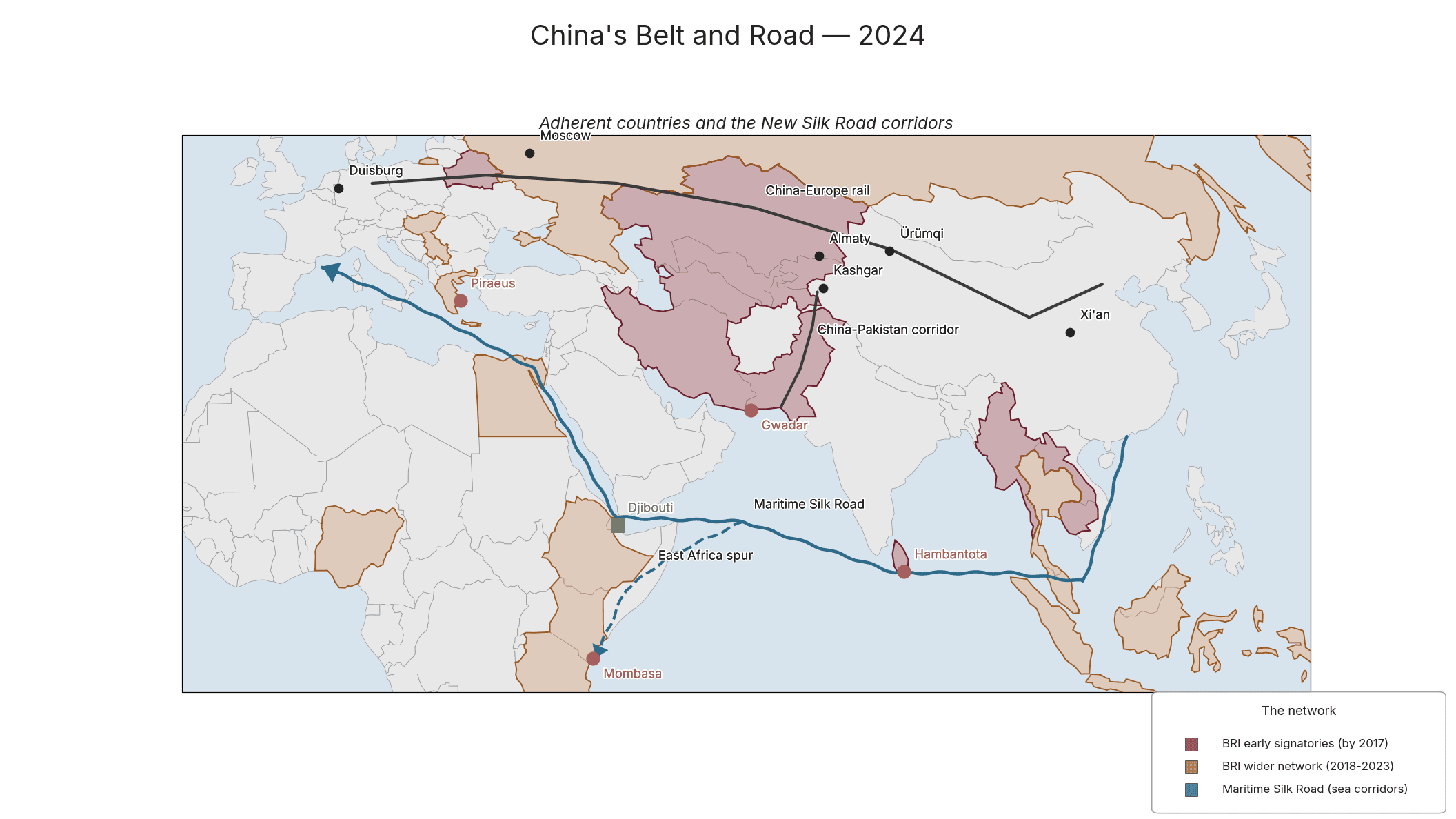
You already know what the map should say. The hard part was never the argument — it was turning the argument into an image that is accurate, coherent, and honest about its own choices. That is the step Gesta Carta collapses. You write what you mean, in a paragraph, and you get back a map you can keep editing by talking to it.
Write the claim, not the drawing
Start the way you would start a note to a colleague. The Russian sphere of influence over the South Caucasus, an arrow of pressure from Moscow toward Tbilisi, Armenia shaded as aligned, Georgia contested. You are not describing pixels — line weights, hex codes, coordinates. You are stating relations between named things. That is exactly the level the tool works at.
Behind the scenes, the AI never draws. It writes a structured document — a declarative cartographic language — that names your entities and states their relations. A separate, deterministic renderer turns that document into the actual plate, resolving Russia and South Caucasus to authoritative geometry it looks up, not geometry a model invents. Named entities in, real coastlines out. The model cannot hallucinate a border because it never touches one.
Then edit by conversation
The first map is a draft, and drafts are meant to be argued with. So you keep talking: make the Russian zone larger. Remove Belarus from the sphere. Add a second arrow, Tehran to Damascus. Move the legend to the lower left. Each instruction becomes a small, typed edit to the document — an operation on a specific element, not a fresh regeneration of the whole image. Nothing else on the map shifts underneath you. The coastline you liked stays exactly where it was.
This is the difference between editing a document and rerolling a slot machine. Image generators give you a new accident every time you ask. Here, the map has an identity that persists across every change, because underneath it there is always the same editable, versionable source of truth.
Not a pin-drop tool, not image generation
It is worth being precise about what this is not. It is not dropping markers onto a base map — the geography is real and editorial, not a Google Maps screenshot. It is not a model painting a picture — there is a document behind every plate, one you can read, correct, version, and cite. And it is not only for geopolitics: the same paragraph-to-map path draws election results, supply chains, language families, historical campaigns — any thesis that lives on a map.
Why the paragraph matters
The reason to start from prose is not convenience. It is that the paragraph is where your expertise already lives. You should spend your judgement on what the map argues — which country belongs in the sphere, where the pressure really points, which contested line to honor — and spend none of it fighting an illustration tool. The map is downstream of the sentence. Get the sentence right, and the plate follows.